How to convince your boss
Today on "As the Fishbowl Turns...", you (a bright young fishfood company innovator) are trying to prove to your skeptical boss that your new fishfood formulation (Fish2Whale) will be the Next Big Thing for aquarium enthusiasts everywhere. Specifically, you would like to show that the average growth for fish that chowed down on Fish2Whale was higher than the average growth for fish that got the generic brand.

First you tried saying "Just look at these fish!! Don't they look bigger to you??!!!!" However, despite your exciting use of exclamation points, your boss was not convinced.
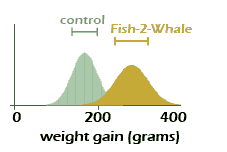 Then you tried showing him each fish population as a normal distribution, and how they barely overlapped:
Your boss looked momentarily interested, but then he grunted something about going fishing that weekend. So now it's up to you. You have one weekend to prove that your results hold water. You tried pretty pictures, and you tried graphs, so now its time for...
(drumroll)... STATISTICS!
Copyright University of Maryland, 2007
You may link to this site for educational purposes.
Please do not copy without permission
requests/questions/feedback email: mathbench@umd.edu